
Commonwealth paid prac is good policy. However medical students must not be left behind
In this article...
Commonwealth paid prac, a missed opportunity
The Australian Government’s decision to expand the Commonwealth Prac Payment to students in ten additional health professions is welcome. The payment is currently up to $338.60 per week, indexed annually and benchmarked to the single Austudy rate. It recognises that compulsory placements can force students to reduce paid employment while meeting additional costs such as travel, parking, accommodation and temporary relocation.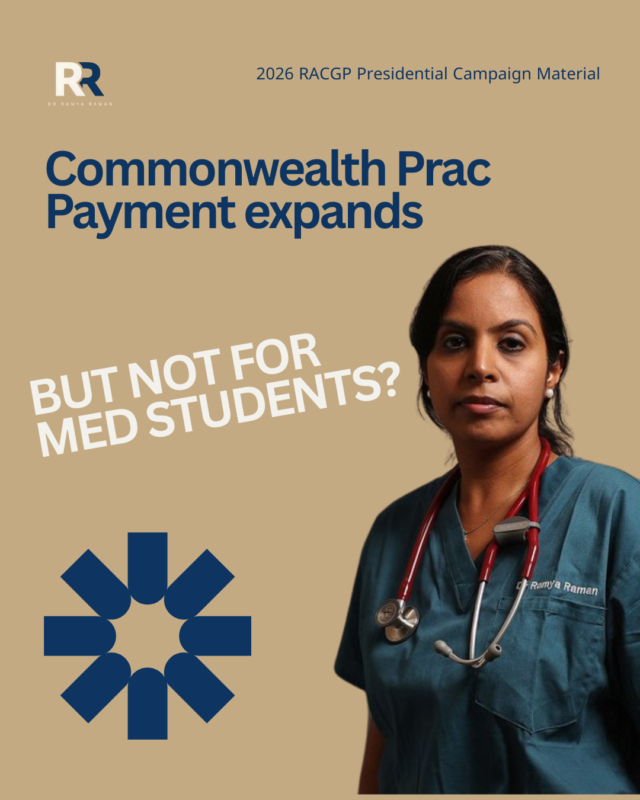
This is a positive investment in Australia’s health workforce.
However, the decision to continue excluding medical students is disappointing, inequitable and difficult to reconcile with the scale of Australia’s medical workforce challenge.
Placement challenges does not become less real because a student is studying medicine. Clinical placements are an essential component of becoming a safe, capable and independent doctor.
Medical students spend extended periods training in hospitals, general practices and community health services. During these placements, many are unable to maintain their usual paid employment but must continue paying tuition fees, rent, transport and everyday living expenses.
The AMA estimates that medical students undertake approximately 2,000 hours of unpaid clinical placement. It warns that these costs create a significant barrier for current and prospective students from rural and lower socioeconomic backgrounds. Medical students face the same cost-of-living pressures, accommodation and travel expenses, and pressure to reduce paid work as students in the professions now included in the scheme.
The financial burden can fall particularly heavily on Aboriginal and Torres Strait Islander students, students from remote and rural communities, students with caring responsibilities and those without access to family financial support. If we are serious about building a workforce that reflects the communities it serves, these barriers cannot be ignored.
The government has rightly acknowledged that travel, accommodation and relocation expenses can discourage students from accepting placements in regional and remote communities, where workforce shortages are often most severe. That reasoning applies equally to medical students.
A rural clinical placement may require a student to leave their existing employment, travel hundreds of kilometres and pay for accommodation away from home while continuing to meet their usual expenses. These experiences are especially important because evidence shows that students from rural and regional backgrounds are more likely to practise outside metropolitan Australia after qualifying.
Paid placements alone will not solve medical workforce maldistribution. Australia also needs strong rural medical schools, strong clinical supervision with remuneration for supervisors, regional internship opportunities, well-supported specialist GP training pathways, and sustainable careers in rural and remote practice.
Removing avoidable financial disincentives is one practical part of that wider strategy.
We cannot continue asking medical students to experience rural medicine while making those experiences financially harder to undertake.
Workforce policy must support the entire pipeline
The exclusion is even more concerning in the context of the Commonwealth’s own workforce projections.
The Whole of Medical Workforce Supply and Demand Compendium Report – June 2026 projects an undersupply of:
- 6,981 full-time-equivalent specialists by 2033, rising to 12,812 by 2048
- 2,398 full-time-equivalent registrars by 2033, rising to 3,885 by 2048.
These figures point to a challenge that is not simply about the total number of doctors. Australia needs the right doctors, in the right specialties, at the right stages of training and in the communities where they are most needed.
That requires policy settings that support the full medical workforce pipeline: from admission to medical school, through clinical placements and internship, and into GP specialist and other training.
Workforce reform must coordinate medical student places, prevocational training positions, GP training and non-GP specialist training places. No single initiative will correct the current maldistribution, however, targeted support at every transition point can make a meaningful difference especially to workforce retention.
Supporting allied health and medicine is not an either-or choice
Calling for medical students to be included does not diminish the importance of extending payments to allied health students.
General practice depends on strong, well-led multidisciplinary teams. Physiotherapists, psychologists, pharmacists, occupational therapists, speech pathologists, paramedics, radiographers, audiologists, podiatrists and rehabilitation professionals all make essential contributions to patient care.
Students entering these professions deserve support during mandatory placements, and the government should be commended for recognising that need.
However, supporting one part of the future health workforce should not require excluding another.
Medical students experience the same basic problem the policy is intended to address: compulsory unpaid training that limits their capacity to earn an income and can require substantial additional costs. The principle should be applied consistently.
A question of equity, access and long-term planning
Extending the Commonwealth Prac Payment to eligible medical students would not remove every barrier in medical education.
It would, however, help students experiencing genuine financial hardship to complete essential training. It would make rural and remote placements more achievable. It would improve equity of access to medical education and demonstrate that the government values the doctors Australia will rely on in the future.
The government should complete the reform
The Commonwealth Prac Payment is sound policy. It recognises that unpaid placement requirements can create serious financial pressure and prevent students from completing the qualifications Australia needs.Those arguments apply to medical students just as clearly as they apply to other health professions.
I call on the Australian Government to reconsider this exclusion and extend means-tested Commonwealth Prac Payments to medical students.
