
General Practice Funding: What I Stand and Fight For
My full position on general practice funding, and what I will fight for as RACGP President.
In this article...
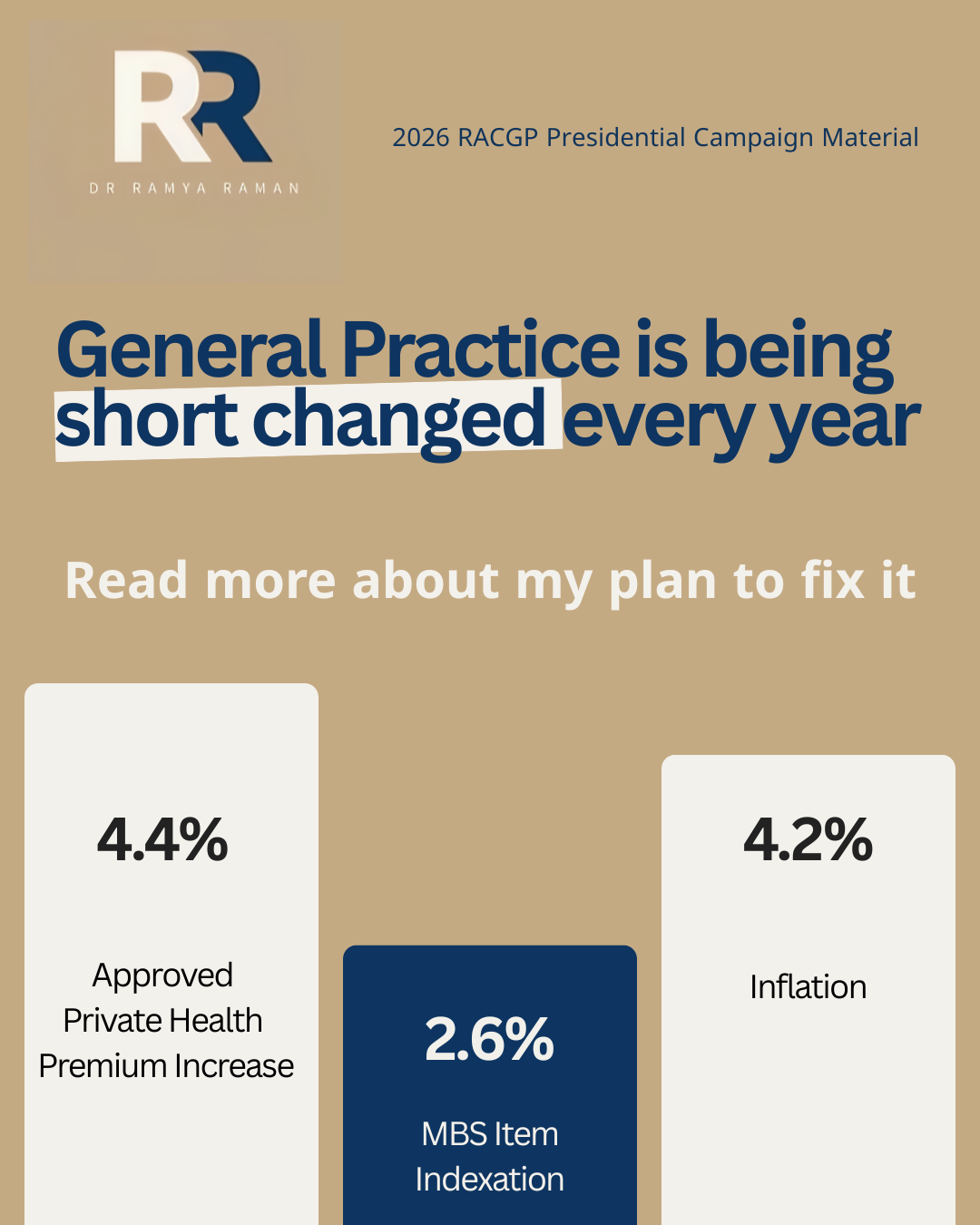
General practice gets short changed every year
Australia needs a funding model that does not short-change general practice every financial year.
It must properly index patient Medicare rebates, value longer and more complex consultations, and recognise the true cost of providing quality care.
Instead, inadequate indexation forces patients, GPs and practices to carry the difference while Medicare increasingly rewards short, transactional care over the time and continuity patients need. I will fight to change that.
The issues that matter for general practice
From 1 July 2026, Medicare rebates increased by just 2.6%.
When the cost of delivering care is rising faster than the rebate, that is not genuine indexation. It is another real-term cut to general practice.
The cost of delivering care increased by over 4% in the year to March 2026.
Every year that indexation falls behind, the difference is carried by patients through higher out-of-pocket costs, by GPs through declining real incomes, and by practices through narrowing margins and reduced services.
1. The Medicare rebate belongs to the patient. It is not the GP’s wage.
I know GPs are infuriated when political messaging presents Medicare as simply paying doctors. The real question is whether the patient’s rebate covers the cost of quality care.
It does not.
The contrast with private health insurance is difficult to ignore. From 1 April 2026, the Australian Government approved an average private health insurance premium increase of 4.41%, while Medicare rebates increased by only 2.6%.
General practice cannot continue to absorb rising costs, regulation and workload while patient rebates fall further behind.
2. Stop using incentives to disguise inadequate rebates
Governments have responded to inadequate rebates with ever-broadening incentives, supplementary payments, eligibility rules and centrally designed programs.
They get away with it because there is no reliable source of general practice consultation data. BEACH was not perfect, but having nothing is worse.
Practices must now navigate MBS rebates, bulk-billing incentives, MyMedicare, workforce payments, chronic disease arrangements, data reporting, quality-improvement requirements and changing digital obligations.
Each new layer may appear manageable on its own. Together, they are taking money away from general practice one administrative bite at a time.
General practice must not be built around more conditions.
3. The NHS is the canary in the coal mine
The UK’s NHS shows where relentless workload, inadequate funding and increasing government control can lead to burnt-out GPs and general practice struggling to survive. Australia must not repeat that mistake by giving practices capped funding while expecting them to absorb unlimited patient need.
The government is playing with fire. We must act before Australian general practice burns out too.
4. Blended funding must add, not replace
Blended funding can support continuity, prevention, coordination and the work that happens outside a consultation.
Used properly, it can help practices care for patients with complex needs, support follow-up and strengthen multidisciplinary care.
But it must be additional. It cannot become a backdoor to lower Medicare rebates, capped budgets, more reporting and greater government control.
General practice cannot be expected to absorb unlimited patient need within a fixed pool of funding. That simply shifts financial risk from government onto practices, while patients carry the consequences.
My action plan to bring more money to general practice
1. More money must be retained in general practice.
Patients are increasingly presenting with multiple conditions, mental-health concerns, medication issues and complex family circumstances. Quality care takes time.
That means:
- Proper indexing of MBS item numbers
- significantly increasing rebates for longer consultations
- recognising multimorbidity and clinical complexity
- restoring and strengthening mental-health consultation items
- properly supporting GP-delivered after-hours care in general practice
- funding the follow-up and continuity patients need
GPs should not be financially penalised for giving patients the time their care requires.
2. Establish an Independent Pricing Authority
Medicare rebates should not depend primarily on annual political decisions or indexation formulas disconnected from the real cost of care.
I will call for an independent pricing authority to:
- calculate the cost of delivering high-quality general practice
- recommend rebates based on consultation time and complexity
- develop transparent risk-adjustment formulas
- recommend annual indexation based on actual practice costs
- assess new workload transferred into general practice
- monitor access, continuity, quality and practice viability
- publish the impact of proposed funding reforms
- protect pricing decisions from short-term political pressures
Its calculations must account for the costs practices actually face, including wages, superannuation, rent, insurance, accreditation, technology, cybersecurity, consumables and regulatory compliance.
A rebate cannot be set at an inadequate level and then declared sustainable simply because it receives annual indexation.
3. Introduce a no unfunded transfer rule
Hospitals and governments are shifting more clinical and administrative work into general practice without funding it.
GPs are expected to complete pre-referral investigations, monitor medicines initiated elsewhere, follow up hospital results, manage post-discharge care and support patients stuck on specialist waiting lists.
Patients still need care while they wait. That workload does not disappear. It lands in general practice.
Any transfer of responsibility must include:
- consultation with GPs
- proper funding and workload assessment
- clear clinical and medicolegal responsibility
- reliable information sharing
- evaluation of patient safety
4. Fund need, not just past use
Past healthcare use does not always reflect actual need.
People facing cost, distance, unstable housing, language barriers or cultural safety concerns may use less care, even when their health needs are greater.
Funding based mainly on recorded diagnoses and previous attendance risks rewarding access already received while overlooking unmet need.
Any funding formula must account for disadvantage, rurality, Aboriginal and Torres Strait Islander health needs, multimorbidity, severe mental illness, disability, homelessness, interpreter needs, aged-care workload and workforce scarcity.
5. Fund multidisciplinary care, but keep clinical responsibility clear
Multidisciplinary teams improve access and outcomes when they are properly integrated into general practice.
Practices should have flexibility to employ the workforce their communities need, including GPs, practice nurses, Aboriginal health workers and practitioners, allied health professionals, mental-health clinicians, pharmacists, care coordinators and administrative staff.
Team members should expand the capacity of general practice, not fragment care or substitute for specialist generalist medical expertise.
6. Protect clinical and business autonomy
Funding reform should establish broad objectives without directing every clinical or operational decision.
GPs and practices must retain:
- clinical judgement
- patient-centred decision-making
- flexibility in team design
- control over prescribing and referral decisions
- the ability to respond to local needs
- legitimate business autonomy
Incentives must not pressure GPs to avoid referrals, delay investigations, limit necessary care or organise their practices around government reporting targets.
Participation in new funding models should be voluntary, transparent and reversible, with independent evaluation before wider implementation.
What I stand and fight for
As RACGP President, I will fight for:
- Proper indexation of Medicare rebates that reflect the real cost of care
- proper support for longer and more complex consultations
- an independent Medicare pricing authority
- protection of GP clinical and business autonomy
- investment in continuity rather than fragmentation
- flexible, multidisciplinary care connected to general practice
I will fight for a strong fairer funding model that gives patients the time, continuity and specialist GP care they need, while keeping general practice sustainable.
