
2026 RACGP Presidential Campaign Material
Standing up for general practice
Ramya has stood up for general practice by pushing back on reforms that risk transferring clinical responsibility onto our profession without the support, governance and resourcing needed to do the work safely.
Patient safety must come before political convenience, rushed implementation or cost-shifting.
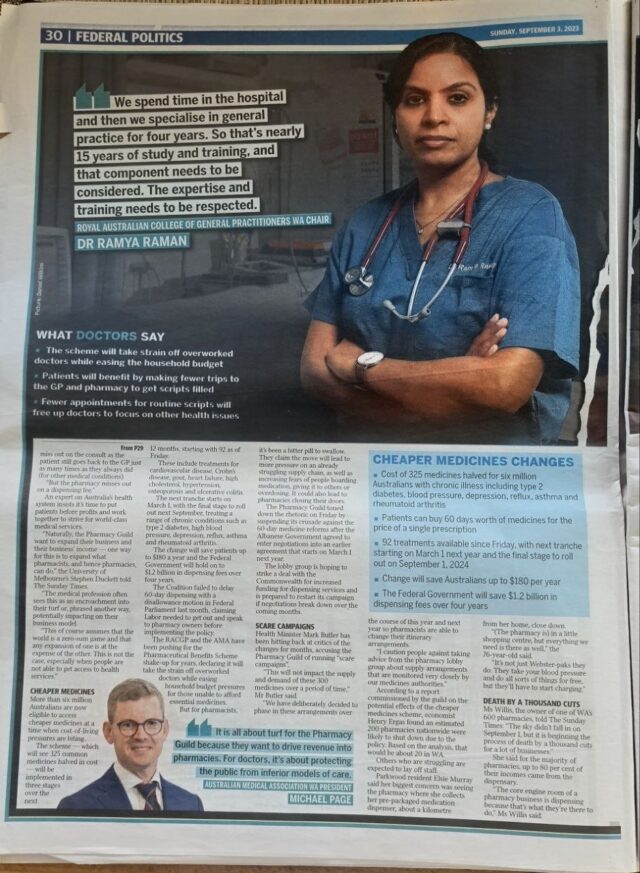
Ramya has been a clear and consistent voice against unsafe pharmacy prescribing expansion, both publicly and behind the scenes.
Her position is simple: access must never be used as an excuse to lower clinical standards, fragment care, or put patient safety at risk.
She has challenged the influence of the Pharmacy Guild of Australia where commercial interests have been allowed to shape health policy in ways that risk undermining patients, antimicrobial stewardship and the role of specialist GPs.
In Western Australia, sustained advocacy helped ensure the current model was made safer than it otherwise could have been. This included successfully pushing for cefalexin to be removed from the pharmacist-initiated UTI prescribing protocol because of local antimicrobial resistance patterns.
But the work is far from finished.
Ramya continues to call for pharmacy prescribing models to be independently evaluated, clinically governed, transparent and accountable. Access matters. But access without safety is not reform.
Health policy must never allow commercial interests to replace comprehensive, specialist GP care.
The GP gender pay gap exposes a deeper problem in the way general practice is funded.
Recent Ochre Health analysis found female GPs bill, on average, $24.14 less per consulting hour than male GPs, equating to around $38,000 less per year when consulting hours are equal.
For Ramya, this is not simply a pay issue. It is a structural issue. Female GPs often carry a high proportion of complex, time-intensive care: mental health, women’s health, chronic disease, multimorbidity, preventive care, perinatal care and care for patients with significant social complexity. This is skilled, comprehensive, patient-centred medicine. But our current rebate system still rewards volume more than complexity.
Ramya has consistently advocated for longer consultations and complex care to be properly valued and funded. A fairer funding model is essential to closing the gender pay gap, supporting women in general practice, and building a workforce that can meet the needs of Australian communities.

WA has more than 80,000 firearm licence holders, with health assessments now required at least every five years, placing GPs at the centre of a high-stakes decision-making process with significant medico-legal and social pressures, particularly in rural communities.
Ramya helped shape a safer, more workable approach to GP involvement in WA’s firearms reform: one that was clearly defined, properly governed, backed by specialist advice and fairly resourced.
Read the letter on the WA Parliament website
She supported stronger public safety, while challenging unresourced clinical, legal and ethical risk being shifted onto general practice.
Ramya helped shape the implementation of ScriptCheck WA so real-time prescribing information was practical for GPs: simple to use, integrated with clinical software, aligned with workflow and focused on education rather than punishment.
That mattered in WA, where 233 people died from unintentional overdoses in 2022.
Ramya backed safer prescribing while making sure the system helped GPs make better decisions without adding unnecessary red tape.
During COVID, when general practice was publicly blamed for hospital pressures and emergency department demand, Ramya stood up for GPs.
She defended the professionalism, commitment and clinical judgement of GPs and practice teams, making clear they were not turning patients away.
They were making careful, clinically appropriate decisions to protect patients, staff and communities while managing respiratory triage, infection control, PPE, workforce furloughing and the risk of COVID spreading through practices.
At a time when GPs needed support, not blame, Ramya called for political leaders to stand behind general practice.
Stay informed. Be ready to vote.
Stay informed. Be ready to vote.
Subscribe for campaign updates, key dates and voting reminders.
We acknowledge the Traditional Owners and Custodians of the lands on which we work throughout Australia. We pay our respects to Aboriginal and Torres Strait Islander Elders past and present and recognise their continuing connection to land, waters, and community.

© 2026 Dr Ramya Raman