
Jacinta Allan’s Pharmacy Shortcut Is Bad for Women, Bad for GPs and Bad for Healthcare
In this article...
Jacinta Allan’s Pharmacy Announcement
The social media reels promoting pharmacy prescribing are coming thick and fast, and the message is becoming impossible to miss.
Victorian Premier Jacinta Allan is not simply announcing access to the contraceptive pill. She is fronting a prescribing power play that positions pharmacy as a substitute for general practice.
This is not just about the pill. It is about a broader attempt to normalise the idea that patients should bypass their GP for more and more parts of primary care.
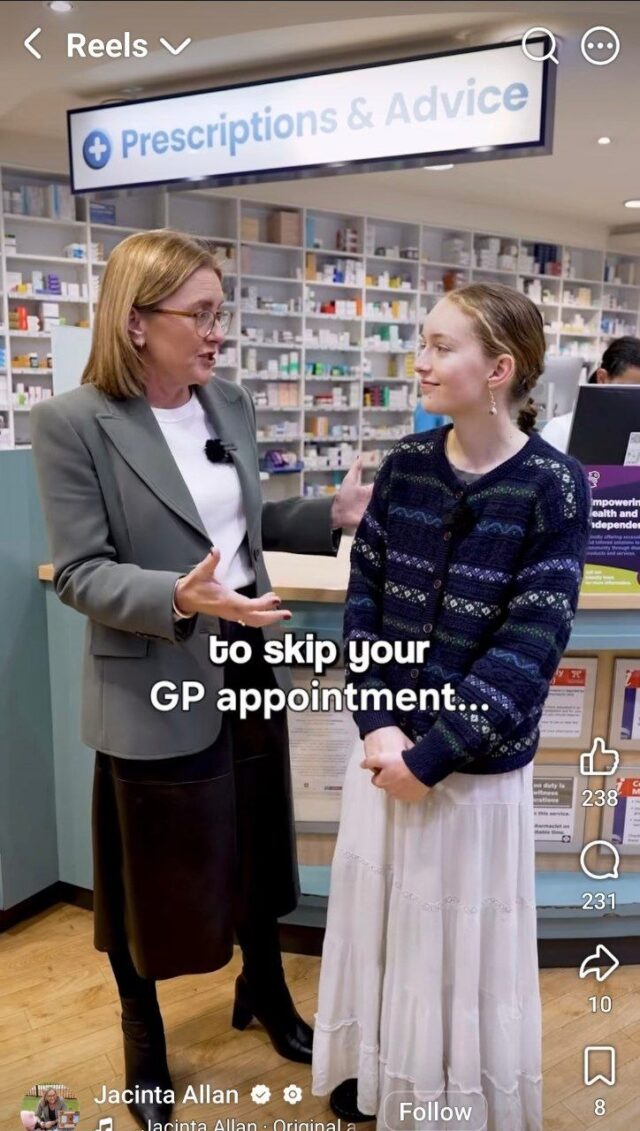 The Pharmacy Guild appears to be working overtime through the list of state premiers and health ministers. The train stopped in New South Wales. Now it has arrived in Victoria. No prizes for guessing where it heads next.
The message being pushed to patients is clear: seeing a GP takes too long, costs too much and gets in the way. That may be effective social media. It may suit the pharmacy lobby. But it is bad health policy.
Women deserve better than a campaign that turns contraception into a retail transaction and presents comprehensive care as an inconvenience.
I am not anti-pharmacist.
The issue is not pharmacists. The problem is state premiers and health ministers rewarding pharmacy-owner lobbying at the expense of patients, GPs and the comprehensive primary care system Australians rely on.
When a Premier stands in front of the public and frames a GP consultation as something women need to be saved from, every GP should pay attention. This is not only a contraception announcement. It is part of a broader strategy to replace comprehensive general practice with fragmented retail prescribing.
Weaponising women’s health to undermine general practice
The oral contraceptive pill is common, but it is still a clinical decision.
A contraception consultation is not just access to a script. It is a chance to assess risk, discuss choices and identify issues that may otherwise be missed.
When this campaign targets younger women, it does more than promote convenience. It normalises fragmented care early in their lives, at the very point when trust, continuity and confidence in healthcare should be built.
The wrong problem is being solved
If women are struggling to get timely, affordable GP care, the answer is not to attack the GP consultation.
The answer is to fund general practice properly.
Governments should be making reproductive healthcare more affordable, supporting longer consultations, improving access to long-acting reversible contraception, and funding team-based care inside general practice. That means GPs, nurses, pharmacists and other health professionals working together around the patient, not being pushed into competing retail pathways.
Instead, Premier Allan has chosen the easier political announcement: send patients to a pharmacy and present it as reform.
That is not system design. That is a shortcut.
It lets governments avoid the harder question: why has general practice been left underfunded for so long that patients now experience cost and waiting time as barriers to essential care?
A prescribing power play is not health policy
There is a difference between improving healthcare access and expanding a commercial model.
Pharmacy-owner lobby groups are not trying to solve a medical accessibility problem. They are solving a commercial viability agenda. Women’s health has simply become the vehicle for that agenda.
That is why the framing is so important. The public message is not “how do we build safer, more connected reproductive healthcare?” It is “GPs take too long, GPs cost too much, pharmacies are easier.”
Add a brand, add a Guild presence in the background, and suddenly a complex clinical issue is packaged as simple consumer convenience.
That is not how we should design primary care.
If this model is safe, necessary and evidence-based, it should be defended on clinical grounds. It should not require a negative campaign against general practice.
Rural patients deserve more than slogans
Rural and regional access is often used to justify pharmacy prescribing. But rural communities do not need a thinner version of healthcare. They need stronger healthcare.
They need general practices that can recruit and retain doctors. They need viable training pathways. They need support for nurses, Aboriginal health workers, pharmacists and allied health professionals to work together. They need funding that reflects distance, workforce shortages and the true cost of providing care.
A rural patient asking for contraception may also need help with abnormal bleeding, migraines, endometriosis, postpartum health, cervical screening, mental health, family violence or medication risk.
This should not be reduced to “no GP visit required”.
The College can be stronger
General practice cannot keep responding to these campaigns after the damage is done.
We need a sharper, more confident RACGP. We need to call out political messaging that undermines GPs. We need to respect pharmacists while challenging pharmacy-owner lobbying. We need to explain to patients that this is not about turf. It is about safety, continuity and the future of comprehensive care.
GPs support better access to contraception. We support women having more choices. We support pharmacists as part of the healthcare team.
But we do not support premiers using women’s health to normalise the idea that general practice is the problem.
We do not support patients being told that the safest, most comprehensive part of the primary care system is an inconvenience.
We do not support governments weakening general practice and then offering retail workarounds as the solution.
Patients deserve a health system, not a sales pitch
Premier Jacinta Allan should be investing in general practice, not undermining it. She should be working with GPs, not standing in front of pharmacy-branded messaging that presents GP care as the obstacle.
Women deserve accessible contraception. They also deserve safe, connected, comprehensive healthcare.
Those two things are not in conflict.
The answer to gaps in general practice is not to bypass general practice. The answer is to strengthen it.
Dr Ramya Raman
